What is an External CFO and how is it different from a Management Office?
An external CFO (also called fractional CFO, part-time CFO, or external chief financial officer) is a senior finance professional who works for your startup on a part-time basis, taking on the strategic functions of a financial director without the cost of a full-time hire.
The fundamental difference is not one of dedication. It is of a temporary orientation.
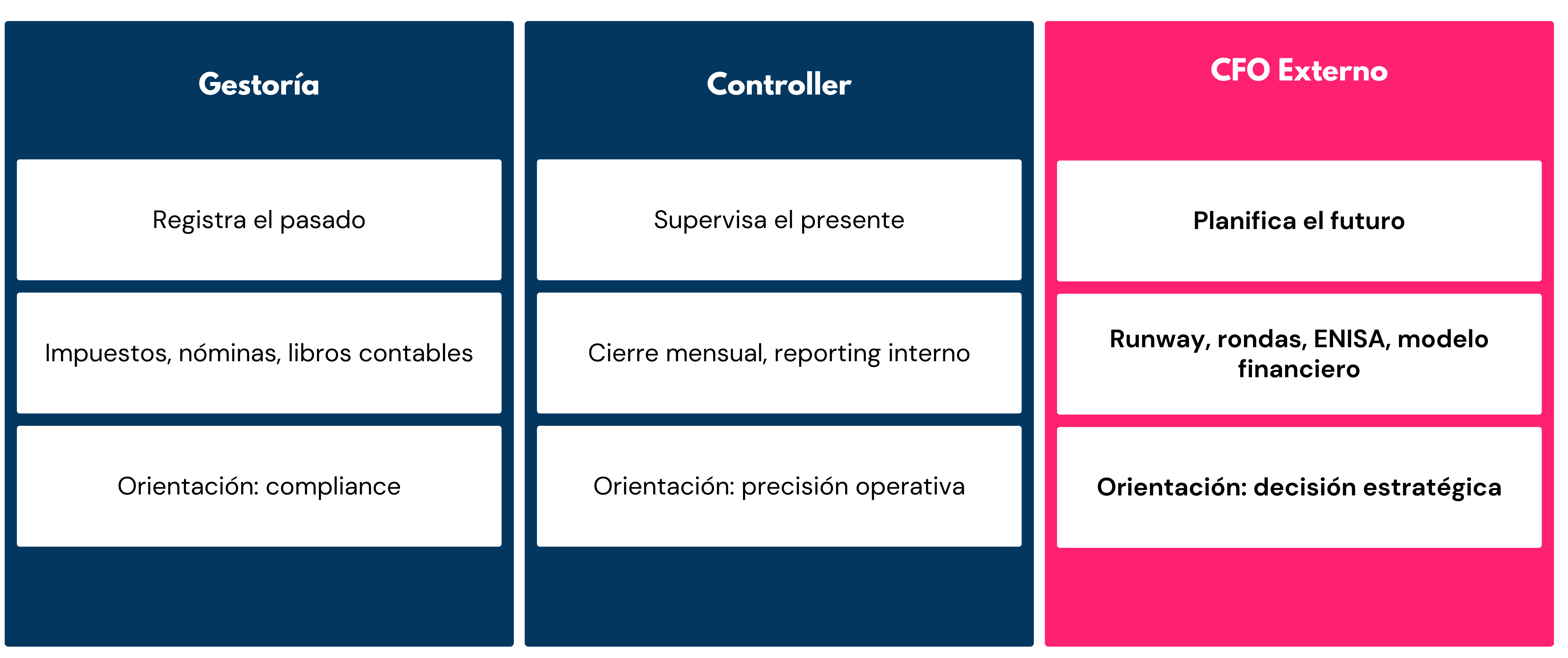
The confusion between these three roles comes at a cost. Founders who hire a manager waiting for CFO work, or an external CFO to do management work, waste money and time before realizing the mistake.
Key Duties of an External Financial Director
1. Accounting Order and Financial Modeling
Think about how a building is built: the foundations come first. If the foundations are not ready for what is to come, the building will most likely collapse shortly after starting to climb it.
The first job of the external CFO is to take control of the accounting: to review how all the expenses have been charged, to balance the accounts with the money you have in the bank, and from there to build future scenarios on a solid foundation.
This includes identifying if R&D is properly activated (many startups lose tax deductions of up to 120,000€/year for not properly documenting it), if expenses are correctly classified between CapEx and OpEx, and if accounting faithfully reflects the operational reality of the business.
2. Runway Box Projections and Scenes
Not a static Excel. A dynamic model with two or three scenarios — conservative, basic and optimistic — that is updated monthly and allows you to make decisions before reaching the limit.
A good external CFO knows that the runway isn't what you have today: it's when it will stop being enough based on your current burn rate.
⚠️ Investor Insight (Patricio Hunt)
I've gotten tired of seeing very complicated models, full of automatisms and formulas, that fail when the vlookup on duty catches the wrong column and the analyst forgot to modify the formula. Call me old-school... but when you have to explain to an investor that you're going to run out of money in two months because there was an error in the financial model, you're going to remember me.
3. Preparing Investment Rounds and Metrics
Investors don't fund startups with confusing numbers. An external CFO translates your business to metrics that an experienced business angel or VC quickly understands:
- Gross Margin and Contribution Margin
- ARR (Annual Recurring Revenue) and NRR (Net Revenue Retention)
- LTV/CAC ratio and payback period
- Burn Multiple (net burn ÷ net new ARR): the modern capital efficiency benchmark
- Rule of 40 (ARR growth rate + FCF margin ≥ 40%)
If those numbers aren't well constructed, a promising meeting dies in due diligence. European investors are more demanding in financial discipline than American investors: with smaller funds and less available capital per startup, each number is scrutinized more rigorously.
4. Non-Diluting Funding Collection (CDTI, ENISA, Horizon Europe)
In Spain and Europe, this is critical. This is where the difference between having or not having an external CFO with experience in the public ecosystem is most dramatic.
Startups with a professional CFO achieve an approval rate of 80% on the first ENISA application, compared to 45% on average. CDTI Neotec's rejection rate is 90%: the difference between approved and rejected is usually in the coherence of the financial and technical plan.
- ENISA: participatory loans from €25,000 to €1,500,000, without guarantees, up to 7 years of grace period
- CDTI Neotec: up to 250,000€ in non-refundable funds for technology startups less than 3 years old
- R&D Deductions: Up to 42% tax deduction on eligible expenses
- European EIC Accelerator: grants of up to 2.5 M€ + equity of up to 10 M€
I have seen startups capture anything from €150,000 to more than €1,000,000 in public funding that the founding team didn't even know existed. An external CFO in Spain must know how to navigate this ecosystem to compensate for the lower valuations paid in Europe compared to the US, and in Spain compared to Europe.
When does your startup need a part-time External CFO?
Clear signs that it's time
- You are preparing for or anticipating a round in the next 6—12 months
- Your monthly burn exceeds €30,000 and you have no visibility for 12 months
- You have investors who ask for structured financial reporting
- You are exploring grants or debt (ENISA, ICO, CDTI, BPI)
- The CEO is dedicating more than 30% of his time to financial issues
- If an investor asked you for the financials tomorrow, you couldn't have them ready in 48 hours
Signs that you don't need it yet
- You're in pre-revenue and your only expense is the founding team
- You have less than 6 months of operation
In that second case, what you need isn't a CFO. It's a well-constructed basic financial model and a controller that helps you with operational management — what we at Intelectium call Advanced Management.
📊 Research-Backed Data
Startups that hire financial support at least 90 days before fundraising report 40% fewer due diligence problems. Those who incorporate an external CFO 6+ months before a round close with a 73% success rate, compared to 34% of those who do so after a first rejection. (Source: K38 Consulting/CFO Advisors 2024-25)

The Most Common Mistakes When Hiring an External CFO (and How to Avoid Them)
Mistake 1: Hiring the cheapest, not the right one
I have seen founders hire someone who “does finance” for 800€ a month and discover six months later that their projections were incorrect, that they had not activated R&D, that they were not aware of the existence of soft loans and grants to which they were entitled, and that their model for the round was indefensible.
The real cost was not the savings of €1,200 per month. It was the rejection of ENISA (125,000 euros lost), the failed round, and six months of work thrown away.
Mistake 2: Hiring a corporate CFO for a startup
A CFO with 20 years in a multinational company doesn't understand unit economics, CAC/LTV, retention cohorts, or SaaS metrics. Speak another language. Startup lifecycle experience matters more than industry experience. Ask how many rounds he has accompanied as CFO over the past three years, not how many years of experience he has.
Mistake 3: Waiting for a problem
60% of founders looking for an external CFO do so when they already have a problem: they run out of cash, are late for a round, or have received a rejection from ENISA. Fixing a financial disaster is 2 to 3 times more expensive than preventing one.
Mistake 4: Not defining specific deliverables
“Financial support” is not a deliverable. Before signing, agree in writing what you are going to receive, in what format and how often: a financial model with 3 scenarios, a monthly report with 10 KPIs, an ENISA report ready to be submitted.
Before hiring, ask three direct questions:
- How many rounds of funding have you accompanied as CFO over the past three years?
- Can you show me a financial model that you have built for a startup in my sector and stage?
- What public funding have you obtained for your clients in the last year and how much in total?
The answers will tell you everything you need to know.
External CFO for Startups FAQs
What's the difference between a Controller and an external CFO?
The controller balances the month: makes sure that the numbers for the period add up, delivers the P&L, explains deviations. The external CFO tells you if you're going to run out of money in Q3 and what you need to do today to avoid it. They are two different jobs. The controller looks at the present; the CFO looks at the road.
What metrics does an external CFO analyze for a SaaS startup?
The fundamentals: Burn Rate, Runway, Gross Margin and MRR/ARR. The advanced ones: Net Revenue Retention (NRR, objective > 110% SMB, > 120% Enterprise), LTV/CAC ratio with windows of 12 and 24 months, Burn Multiple (net burn ÷ net new ARR, healthy below 1.5x), and Rule of 40. A good external CFO doesn't just calculate these metrics — he builds them in a way that a VC understands and trusts them.
Can an external CFO help with ENISA or CDTI?
It is one of the greatest added values in the Spanish context. An external CFO with experience in public funding can help you capture between €150,000 and more than €1,000,000 in non-dilutive funding: ENISA (up to 1.5M€ without guarantees), CDTI Neotec (up to 325,000€ in non-refundable funds), deductions for R+D+i (up to 42% deduction), and the European EIC Accelerator (up to 2.5 M€ in grants). Professionally advised startups have approval rates of 80% compared to 45% on average.
Does the external CFO replace the management?
No. They are complementary roles. The agency is responsible for accounting, taxation and legal obligations. The external CFO works on that basis to do financial planning, capital raising and strategy. You need both, not one instead of the other.
ABOUT THE AUTHOR
Patrick Hunt
Investor and General Partner of Firstech Ventures (European fund of €40M), founder of Intelectium where he has advised more than 500 European startups on financial strategy, investment rounds, public funding and international expansion. With 15 years of experience in the European startup ecosystem, he has accompanied closing round processes, restructuring, M&A and liquidity crisis in companies from seed to Series B.


.png)