
Determine how long your business can operate before it needs additional funding — and if you miscalculate it, the result can be catastrophic.
In this article you will learn how to calculate your financial runway precisely, you will understand the crucial difference between Gross Burn and Net Burn, you will discover the framework 'Default Alive vs. Default Dead' by Paul Graham, and you'll apply scenario analysis to make strategic decisions — not just reactive ones.
What is the Financial Runway and why is it vital for your startup?
The financial runway refers to how long a startup can continue operating before its funds run out. It's the countdown that determines when you'll need new funding or achieve profitability.
Without a clear runway, startups face unexpected financial crises. With it, you can plan ahead, negotiate from a position of strength, and make strategic rather than reactive decisions.
Key relationship: Financial Runway = Available Capital/Monthly Burn Rate
Gross Burn vs. Net Burn: The Distinction That Changes Everything
This is the most common mistake when calculating the runway: confusing gross expense with net expense. The difference is fundamental and can radically change your estimate.

As you can see, the same startup with the same €300,000 in cash can have 8.5 months or 13 months of runway depending on whether you use Gross or Net Burn. Investors always ask about Net Burn, which is the honest metric.
Complete Financial Runway Formula
Runway = Cash Capital/Monthly Net Burn Rate
Net Burn = Gross Burn (total expenses) — MRR (monthly recurring income)
Practical example with both metrics
Suppose your startup has the following numbers:
- Available capital: €300,000
- Total monthly expenses (Gross Burn): €35,000
- Monthly Recurring Revenue (MRR): €12,000
Calculation:
Gross Burn Runway = €300,000/€35,000 = 8.5 months
Net Burn = €35,000 — €12,000 = €23,000
Net Burn Runway = €300,000/€23,000 = 13 months ← use this for your decisions
Difference: +4.5 months thanks to recurring revenues. That can make the difference between a successful round and a close.
Default Alive vs. Default Dead: The Paul Graham Framework
Paul Graham (Y Combinator) popularized one of the most powerful analyses in the startup world: determining if your company is 'Default Alive' or 'Default Dead'. This one goes beyond simply calculating how many months you have left.
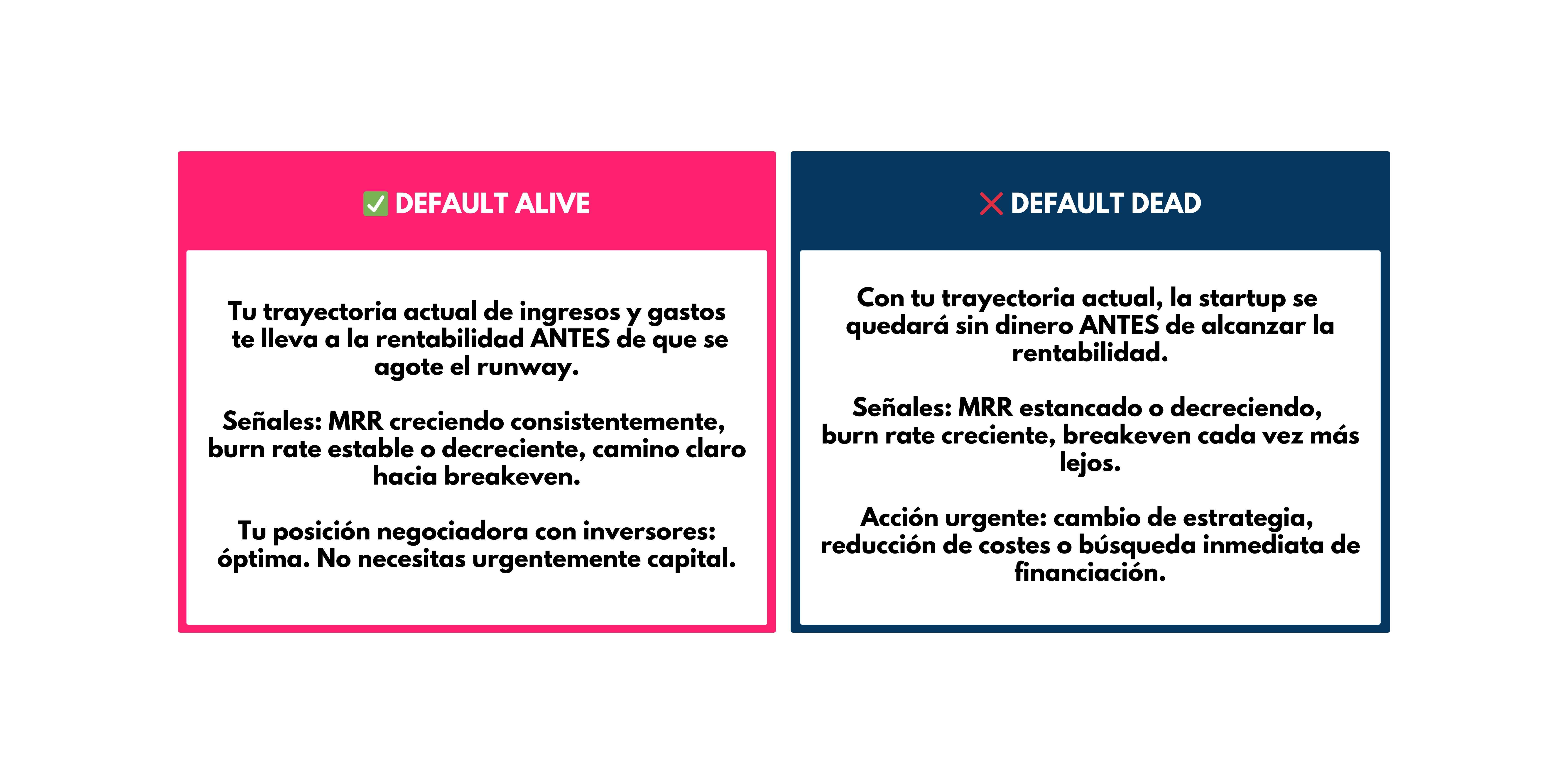
How to calculate if you are Default Alive
To find out, you need to project three variables over the next 18-24 months:
- MRR projection (assumes your current monthly growth rate)
- Projected expenditures (do they scale with growth or are they fixed?)
- Crossover point: in which month do revenues exceed expenses?
Paul Graham's rule:
If you need something to change radically (new large customer, new round, drastic cost reduction) to survive... you're Default Dead.
If with your current trajectory, maintaining the same rate of growth, you reach breakeven before running out of cash... you are Default Alive.
Source: Y Combinator — 'Default Alive or Default Dead? ' (Paul Graham, 2015)
Scenario Analysis: Don't Limit Yourself to a Static Formula
The biggest mistake is to calculate the runway only once and forget. The reality changes: you lose a key customer, you get an important contract, or the market collapses. You must have three live and up to date scenarios.
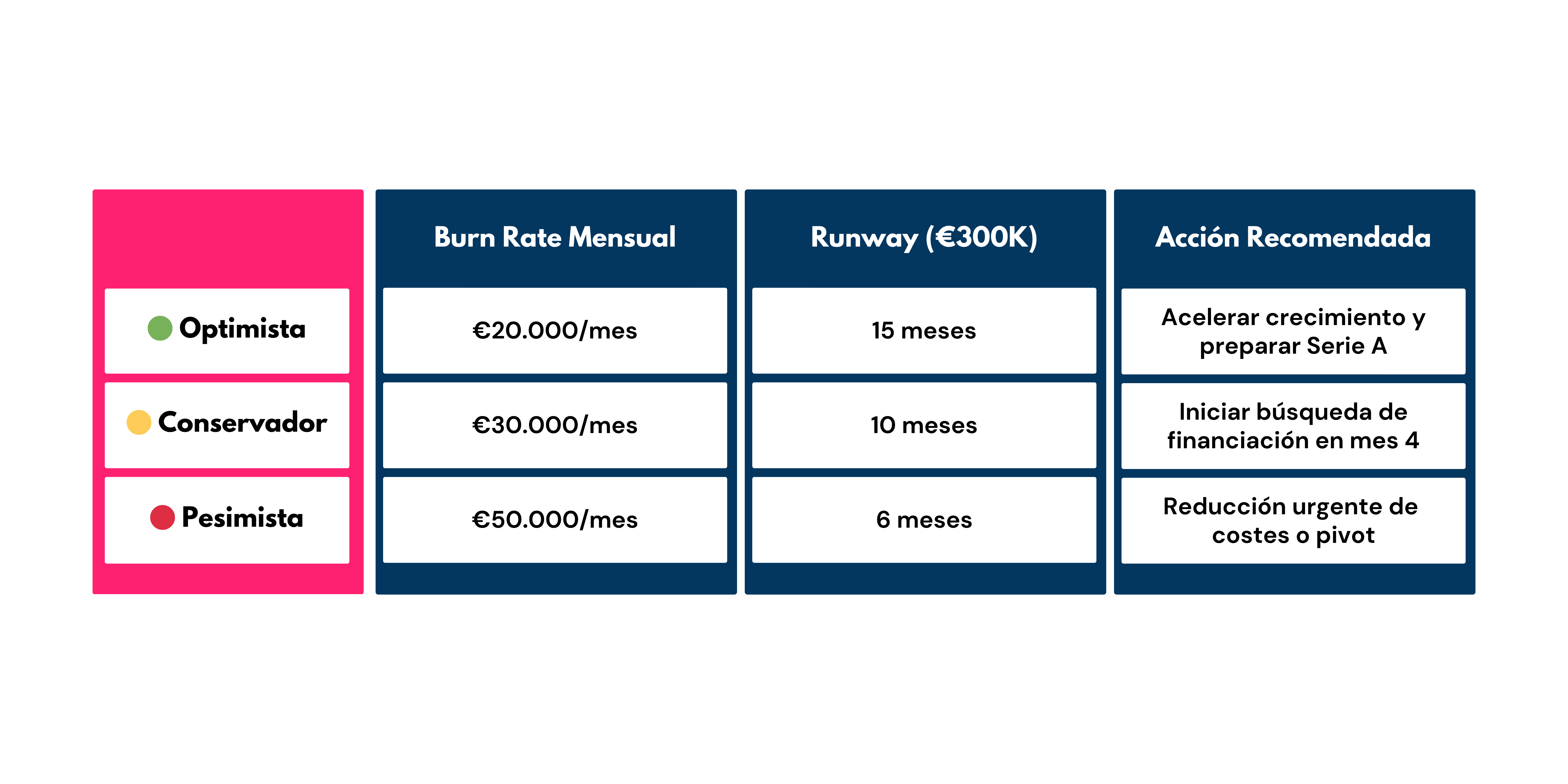
This analysis allows you to answer critical questions: in which month should I start looking for worst-case funding? Do I have room to hire if the scenario is optimistic? How much do I have to reduce the burn to survive the pessimistic scenario?
The Safety Buffer: Never Plan Until Month 0
This is one of the most common and most costly mistakes in runway management: waiting too long to seek funding.
⚠️ Runway Golden Rule:
Start looking for funding when you have at least 6 months left on runway.
Why 6 months? Because a funding round — from the first email to the wire transfer — lasts between 3 and 6 months in Europe. If you wait until you're 3 months old, it's too late.
Investors know this and will use it to trade against you.
The real timeline of a funding round
- Weeks 1-4: Deck preparation, financial model and materials
- Weeks 5-8: Initial Outreach, First Meetings
- Weeks 9-16: Due Diligence, Negotiating Terms
- Weeks 17-24: Signing of contracts, legal formalities, collection
In total: between 4 and 6 months. There are exceptions, but planning on exceptions is financial Russian roulette.
How Many Months of Runway Are Recommended for a SaaS Startup?
The answer varies depending on the stage, but as a general reference for European SaaS startups:
- Pre-seed/Idea: minimum 12 months to iterate the product
- Seed: 18-24 months is the standard that Seed investors ask for
- Series A: 18 months post-round, with visibility up to Series B
- Startups with MRR: the Net Burn Runway becomes more relevant than the Gross
The industry standard in Europe (according to data from Atomico State of European Tech 2023) is that Seed startups seek to close a round when they have left 12-18 months of Runway. Those who are less than 9 months old trade from a very weak position.
Strategies for Optimizing the Runway: More than Surviving, Investing Better
Runway management isn't just about lasting longer — it's about investing available capital strategically to maximize the value created. Here's the difference between a startup that survives and one that leads its category.
Reduce burn without compromising growth
- Cloud infrastructure optimization: SaaS companies can reduce their AWS/GCP costs by 20-30% by reviewing sizing on a quarterly basis
- Annual contracts with suppliers: pay annually (if you have a cash register) in exchange for discounts of 15-40%
- Automation of repetitive processes: each automated process frees up human capacity for higher-value work
- Remote-first: eliminates or reduces office costs without affecting productivity
Increase revenue to reduce Net Burn
- Annual Prepaid: Offers a 15-20% discount in exchange for charging 12 months in advance. Upgrade your box immediately
- Expanding existing accounts (NRR > 100%): growing with existing customers is 5-7x cheaper than acquiring new ones
- Professional services/payment onboarding: generate cash while scaling the product
Strategic management of capital
- Always keep 2-3 months of “untouchable” reserve for unforeseen events
- Separate operating accounts from runway reserves
- Monitor the runway in real time, not monthly
Real Cases: How the Best Startups Managed Their Runway
Airbnb: Survive to Lead
In 2009, Airbnb had been running for less than a year and was on the verge of closing. The founders topped the box with sales of special-edition cereals (“Obama O's”). The critical thing was that they obsessively controlled their burn rate and extended the runway far enough to demonstrate traction. Lesson: With a well-managed runway, even a few months are enough to change course.
Slack: Efficient Growth
Slack maintained a relatively low Net Burn rate in its early years because it grew primarily through word of mouth (viral growth), with almost zero CAC. Its runway was artificially long thanks to an NRR of more than 140%. The lesson: Reducing Net Burn isn't just about cutting expenses, it's about maximizing income per unit of cash invested.
Factorial (Spain): Runway Management in the Post-2022 Crisis
The Spanish HR startup Factorial — one of the most important in the Iberian ecosystem — navigated the post-2022 environment (rising rates, shrinking European venture capital) with a clear strategy: it prioritized the path to profitability over growth at any cost. It extended its runway by reducing Net Burn without sacrificing its engineering equipment, thus maintaining the competitive advantage in the product. A more relevant local example than Silicon Valley in the 2000s for today's European entrepreneur.
Reference sources for industry data:
• Crunchbase (crunchbase.com): funding, rounds and valuation trends
• Y Combinator Startup School (startupschool.org): standard frameworks and metrics
• Atomico State of European Tech: benchmark of European startups
• Dealroom.co: investment data in the European ecosystem
Tools to Manage Your Financial Runway
Financial Tracking Software
- Pleo + Xero/QuickBooks: real-time expense tracking and automated monthly closing
- Causal.app: financial modeling tool for startups, with visual scenarios
- Runway (runwayapp.io): specifically designed to calculate and monitor runway in real time
- Brex/Ramp: corporate cards with automatic expense categorization
💡 Free Template: Burn Rate and Runway Control
📥 Download the Excel/Google Sheets Template
It includes: automatic calculation of Gross and Net Burn, 24-month runway projection, analysis of three scenarios and monthly cash flow chart.
None of our competitors offer this for free and prominently.
Access hither
Integrating Growth Metrics with the Financial Runway
The runway doesn't exist in a vacuum. Growth metrics are constantly changing it:
- MRR growth rate: Every percentage point of improvement in monthly growth reduces your Net Burn and extends the runway
- Net Revenue Retention (NRR): If it exceeds 100%, your runway automatically improves every month without doing anything
- CAC Payback Period: In how many months do you recover the cost of acquiring a customer? If you are less than 12 months in B2B SaaS, you have an efficient cash engine
- LTV/CAC ratio: minimum 3:1 so that growth does not consume more cash than it generates
Integrating these metrics with your runway model gives you the full picture: not just how long your money lasts, but whether the business engine makes financial sense.
Financial Runway FAQs
When should I start looking for funding?
When you have at least 6 months of runway left in your conservative setting. Never be pessimistic — there you will already be trading at a disadvantage.
Is Gross Burn or Net Burn better for communicating to investors?
It always features the Net Burn. It's the honest metric and the one that investors use to evaluate the efficiency of their capital. Presenting only the Gross Burn may seem like you're hiding information.
How to calculate the financial runway in Excel?
Create a table with: (1) row of initial capital, (2) columns of months, (3) sum of monthly expenses, (4) projected MRR, (5) Net Burn = expenses — MRR, (6) accumulated cash = previous month cash — net burn. The runway is the month when the box reaches 0. Download our free template to have it ready in 5 minutes.
What is the difference between financial runway and burn rate?
These are complementary concepts: the burn rate is the speed of consumption (€/month), the runway is the time you have left (months). High burn rate = short runway. They are the two sides of the same coin.
Does the financial runway apply equally to SaaS startups and hardware startups?
No. SaaS startups have gross margins of 60-80% and can improve their Net Burn quickly. Hardware ones have low gross margins, high capex and slower cash cycles. For SaaS, Net Burn is the key metric. For hardware, you have to add the inventory cycle and collection times.


.png)
.png)