
More sales, more competition and ever tighter margins. Growth is no longer enough: you have to grow profitably. And that requires a financial address that most ecommerce founders don't have.
The biggest hidden cost of ecommerce isn't in logistics or marketing. It's in the time that the CEO spends each week on financial management that he shouldn't be doing.
Review the accounting closing, keep track of the treasury, prepare reports, control inventory from a financial perspective... These are tasks that can easily be accumulated in 8-10 hours a week. Hours that aren't spent on product, customers, or equipment.
That time comes at a price. And it rarely appears in any Excel.
Added to this is a structural problem: many ecommerce founders manage finances with the wrong tools. The management company does the accounting and the taxes, but it does not analyze the margin by product, it does not build cash forecasting models or assist in an investment round. That's what the CFO exists for.
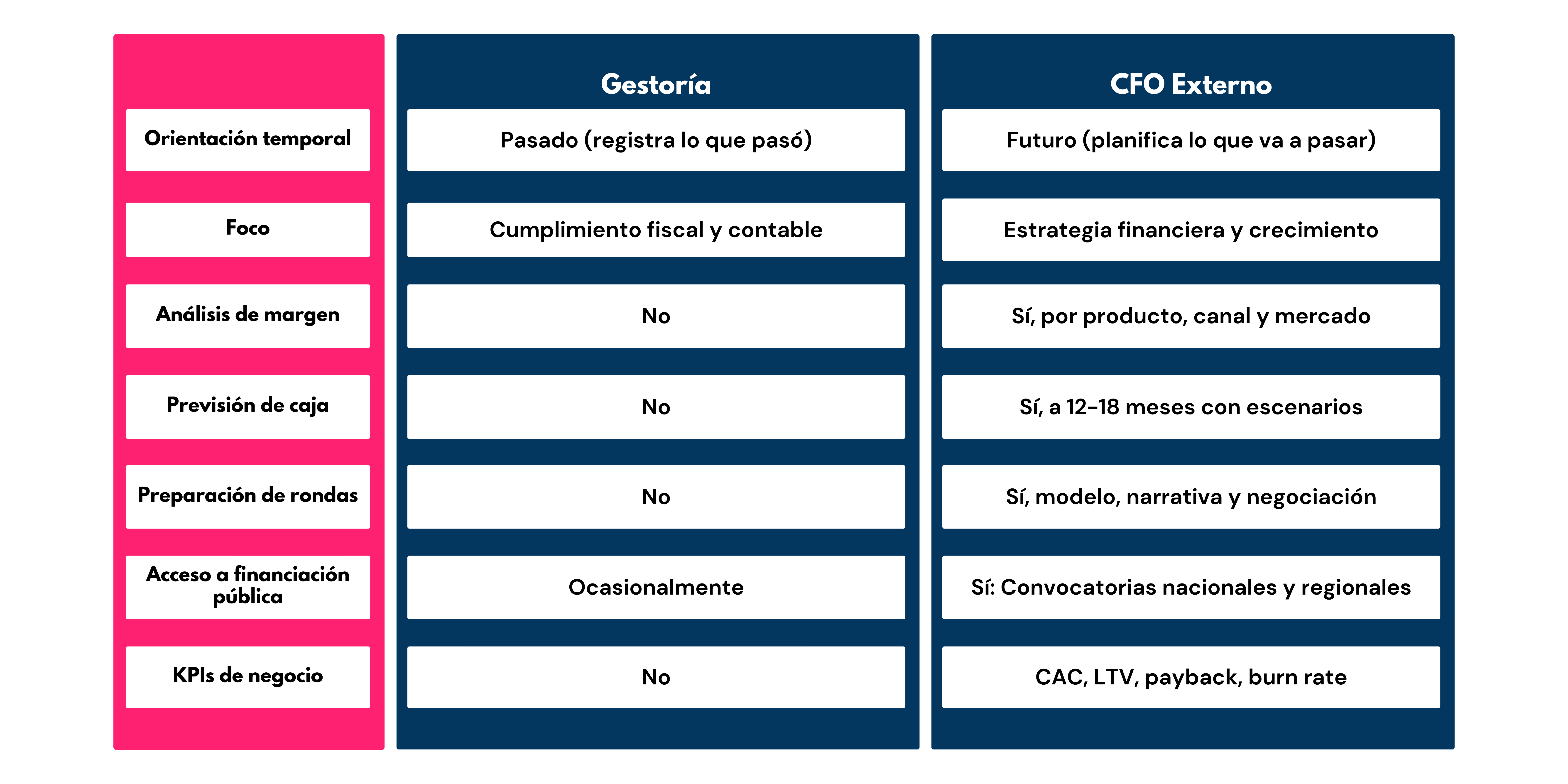
What an External CFO does that an agency doesn't
The confusion between management and CFO is one of the most common, and most expensive, mistakes in ecommerce.
The 7 critical financial KPIs of an ecommerce
One of the first jobs of an e-commerce CFO is to establish what metrics really matter and build the system to measure them reliably. These are the seven indicators that no growing ecommerce should lose sight of:
1. Contribution margin by SKU or category
Not the generic gross margin, the actual margin that remains after subtracting product costs, logistics, returns, payment commissions and discounts applied. In many ecommerce stores, between 20% and 30% of the catalog has negative contribution margins or less than 5%. Scaling it destroys value, not creates it.
Benchmark Benchmark: The average gross margin of the ecommerce sector is between 30% and 50% for direct-to-consumer brands. The sector's average net margin was 9.2% in 2024. If your net profit margin is below 5%, there is urgent optimization work.
2. CAC by acquisition channel
The cost of customer acquisition broken down by channel (Google Ads, Meta, SEO, email, marketplace). Not the average CAC, the actual CAC for each channel, including agency costs, tools and team time. A channel that apparently performs well in volume may have a CAC that makes profitability impossible.
3. LTV/CAC ratio and payback period
The LTV/CAC ratio should be above 3x for the model to be sustainable. The payback period (the time it takes for investment in funding to recover) should be below 12 months in most categories. If it exceeds 18 months, the funding model is financing growth with cash that you don't have.
4. Cash Conversion Cycle (CCC)
The cash conversion cycle measures how many days it takes for money to come out (payment to suppliers, stock) and return (sales collection). In ecommerce with a physical product, this indicator is critical: a high CCC means that you have capital tied up in inventory that you can't use to grow.
5. Return rate on sales and its impact on margin
Ecommerce returns in Spain range from 15% to 30%, depending on the category. Each return has a logistical, operational and opportunity cost that is rarely correctly reflected in the P&L. A CFO constructs the real cost per return model and identifies if there are categories or channels that generate abnormal rates.
6. Runway and Burn Rate
If ecommerce is in a growth phase and invests more than it generates, the runway is the most important survival metric. Dividing the available cash by the monthly burn rate indicates how many months are left before you need funding or generate positive cash. Knowing this data precisely - and keeping it updated monthly - is the responsibility of the CFO.
7. Margin-adjusted ROAS
The ROAS (Return on Ad Spend) reported by advertising platforms does not take into account product cost, logistics or returns. Margin-adjusted ROAS is the only metric that allows us to know if a marketing campaign is truly profitable. A 4x ROAS can be excellent or catastrophic depending on the margin of the product you're selling.
Margin Control: How to Detect Products That Destroy Value
In practice, one of the first analyses we carry out at Intelectium when we accompany an e-commerce as an External CFO is to build the real margin model by product or category.
The process consists of assigning to each product line all the costs that actually correspond to it: product cost, packaging, shipping logistics, average return rate, payment gateway cost, marketplace commission if applicable, and the proportion of discounts and promotions used to sell that product.
The result is often surprising. Some products that generate a lot of sales and seem strategic have zero or negative contribution margins when all costs are analyzed. Others, with less volume, are the ones that really sustain the profitability of the business.
This analysis makes it possible to make concrete decisions: removing references from the catalog, adjusting prices, renegotiating conditions with suppliers, redesigning the discount strategy or redirecting marketing investment to products that actually generate value.
Cash management and seasonality: the most underestimated financial challenge of ecommerce
An ecommerce can have increasing sales and, even so, run out of cash. The reason: growth in ecommerce requires investment before charging. In stock, in marketing, in technology, etc. And that temporary gap can generate liquidity crises even in profitable businesses.
To this is added seasonality. In many ecommerce stores, between 30% and 40% of annual sales are concentrated in the last three months of the year: Black Friday, Christmas and sales. Financially preparing for that campaign requires you to start planning six months in advance.
The CFO's work in this area includes:
- 12-18 month cash forecast model with three scenarios (conservative, basic and optimistic), updated monthly and aligned with the sales plan, marketing investment and stock needs.
- Working Capital Planning for seasonal campaigns: when stock has to be committed, when available cash is needed and how to structure funding if there is a gap.
- Analysis of CCC improvement levers: negotiation of deadlines with suppliers, optimization of inventory turnover, management of collection deadlines in marketplaces.
- Early Alerts: identify in good time when the box can reach critical levels, so that there is time to act — not to react.
Public funding for ecommerce: what almost no one takes advantage of
This is the point where Intelectium provides a differential advantage that most financial advisors do not offer.
Many e-commerce businesses in the growth phase have access to public funding that they are completely unaware of. The main instruments:
- CDTI — R&D Projects: if e-commerce has its own technological development (recommendation engine, customization, dynamic pricing tools, logistics automation), it can finance up to 85% of the development budget with very favorable conditions: up to 33% in non-refundable funds, Euribor interest rate +0% and up to 15 years of amortization.
- ENISA — Participatory Loans: financing from €25,000 to €1,500,000 without the need for guarantees, with up to 7 years of grace period. Especially suitable for e-commerce in the scaling phase that needs capital to grow without diluting the shareholder base.
- Research Staff Bonuses: If e-commerce has developers or technical staff dedicated to building their own technology, savings of 40% can be applied to the Social Security contribution of these workers from the time of hiring. Many companies are unaware of this and allow thousands of euros to pass through each year.
- Tax deductions for R+D+i: up to 42% corporate tax deduction on eligible research and development expenses. An e-commerce that invests in its own technology may be missing a very significant deduction for not properly documenting its technical activities.
Effective access to these instruments requires knowing which ones apply to each case, to prepare the documentation correctly and to synchronize the public funding strategy with the private one. It's one of the areas where specific experience makes the most difference.
Preparing for Finance and Growth
As an ecommerce scale, it reaches a point where it needs external capital to continue growing: financing stock for a volume jump, investing in technology, opening up new markets or filling the cash gap of a large scale seasonal campaign.
The External CFO plays a central role in this three-dimensional process:
- Optimal funding structure. Not all capital should be equity. In ecommerce, the combination of bank debt, working capital lines of credit, public funding and eventually private investment can significantly reduce the dilution of the founding team. Defining that structure is a strategic decision that has a direct impact on the cap table in the long term.
- Preparedness for investors. If a private investment round is contemplated, the CFO builds the financial model that underpins the valuation, prepares the data room, develops the financial narrative for the deck and assists in the negotiation of terms: pre-money valuation, equity to be transferred, terms of the termsheet. Arriving without this preparation can cost an additional 10% to 20% dilution.
- Access to non-dilutive funding. Before planning a round, a good CFO always evaluates what public funding is available. Every euro raised in CDTI or ENISA is a euro that should not be obtained from investors and that does not dilute the founder.
When is it time to hire an External CFO in your ecommerce?
There are clear signs that current financial management is no longer sufficient for the state of the business:
- You make more than €500,000 per year but you don't have a clear view of the real margin per product
- The CEO dedicates more than 4 hours a week to financial and treasury tasks
- You don't have a cash forecast model that is updated monthly
- You have an important seasonal campaign (Black Friday, Christmas) and you haven't planned the treasury in advance
- Are you thinking about lifting a round or asking for bank funding in the next 12 months?
- Your margins have fallen even though sales have risen
- You have several product lines or sales channels but you don't know which one generates the most real value
If you recognize more than two of these situations, you're probably already at the point where adding an External CFO has an immediate and clear return.
Financial checklist for ecommerce
A quick way to assess the financial maturity of your business. You should be able to answer “yes” to all of these questions:
Profitability
- Do you know the actual contribution margin for each product or category, including logistics and returns?
- Do you know which sales channels are really profitable after charging all the costs?
Liquidity
- Do you have a cash forecast for the next 12 months updated this month?
- Do you know exactly how many runway months you have today?
Marketing and recruitment
- Do you know the actual CAC by channel, including all associated costs?
- Do you measure margin-adjusted ROAS, not just platform ROAS?
Seasonality
- Do you have the treasury planned for your next seasonal campaign at least 3 months in advance?
Funding
- Have you evaluated what public funding (CDTI, ENISA, bonuses) applies to your company this year?
- Do you have an up-to-date financial model that you can submit to a bank or investor today?
If any of these questions are difficult to answer, it's time to reinforce the financial area of the business.
How Intelectium works as external e-commerce CFO
At Intelectium, we support e-commerce and technology startups as External CFO. Our work covers three fundamental areas: financial control and visibility, margin optimization and pricing, and fundraising: both private and access to public funding.
Unlike a generalist consultancy, we have been in the ecosystem of startups and Spanish digital companies for more than 20 years. We have accompanied more than 450 companies and closed more than 50 investment rounds.
Every startup we work with has a reference person. Someone who knows the business, the context and is available when needed.
If you want to know if it makes sense to work together, the first step is a free 30-minute diagnostic session: we analyze your current financial situation and tell you exactly which levers to activate.